Moon Phases
Moon Phases and Their Meaning, a Gentle Guide to All 8 Phases
What do the moon phases mean? A gentle guide to all 8 phases of the lunar cycle, with a journal prompt for each phase and a simple monthly ritual.
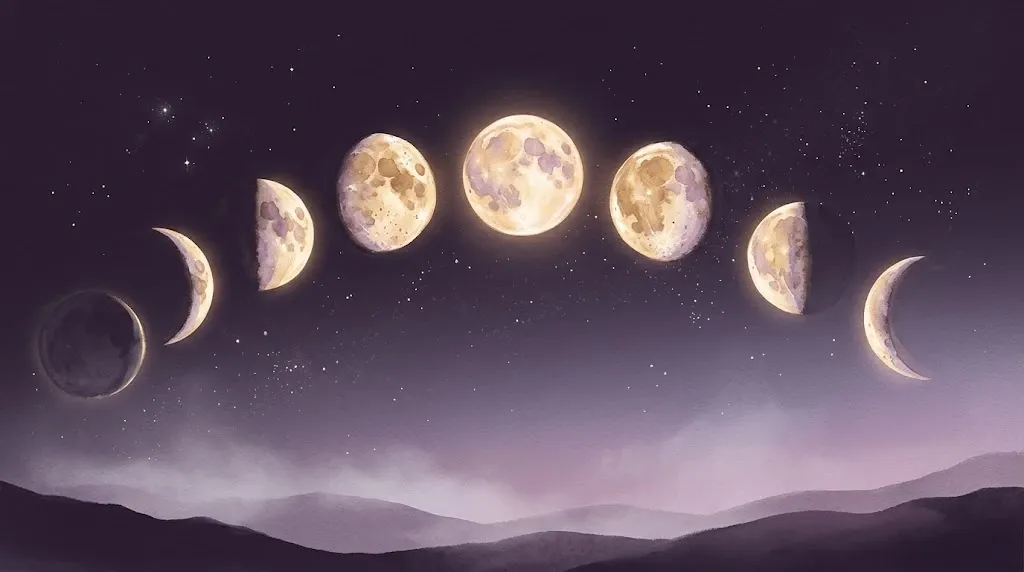
For as long as people have looked up at night, the moon has been a way to mark time. It grows, it fades, it disappears and returns, about every twenty-nine and a half days. Long before calendars hung on walls, this cycle shaped planting, festivals and stories.
You do not need to follow astrology to find meaning in the moon phases. The lunar cycle is simply a beautiful, reliable rhythm, and rhythms are good companions for reflection. This guide explains the eight moon phases and their meaning, and offers a journal prompt for each one, so you can use the moon as a gentle prompt for your own inner work.
The 8 moon phases at a glance
| Phase | What you see | Theme | Journal prompt |
|---|---|---|---|
| New Moon | The moon is not visible | Beginnings, intention | What do I want to grow? |
| Waxing Crescent | A thin sliver after sunset | First steps | What small step can I take? |
| First Quarter | The right half is lit | Decision | What do I need to choose? |
| Waxing Gibbous | More than half, still growing | Refining, patience | What needs adjusting? |
| Full Moon | The whole face is lit | Culmination | What has come to light? |
| Waning Gibbous | Light shrinking from the right | Gratitude, sharing | What have I learned? |
| Last Quarter | The left half is lit | Release | What can I let go of? |
| Waning Crescent | A thin sliver before dawn | Rest | Where do I need rest? |
The descriptions of what you see apply to the Northern Hemisphere. In the Southern Hemisphere the moon appears mirrored, so the lit side is on the opposite side.
Why use the moon phases for reflection?
Modern life runs on weeks, deadlines and notifications. The moon runs on something slower. Pausing a few times a month to notice where it is in the sky can be a small act of stepping back.
The moon also offers a natural shape for reflection: a beginning, a building, a peak, a release and a rest. Many traditions have attached intentions and rituals to these moments. You can borrow what resonates and leave the rest.
What each moon phase means
New Moon
The moon sits between the earth and the sun, and its lit side faces away from us. The sky is at its darkest.
Meaning: a time of beginnings and quiet. It is a good night to set an intention for the cycle ahead.
Reflect: What do I want to grow this month? What am I ready to begin?
Waxing Crescent
A thin sliver of light appears on the right side of the moon, low in the western sky shortly after sunset.
Meaning: first steps. The intention you set is still fragile, and that is fine.
Reflect: What is one small action I can take toward my intention?
First Quarter
Half of the moon is lit. It is about a week into the cycle, and the moon is high in the sky at sunset.
Meaning: challenge and decision, the point where an idea meets real life.
Reflect: What is getting in my way? What do I need to choose?
Waxing Gibbous
More than half of the moon is lit, and it keeps growing toward full. You can see it from the afternoon through most of the night.
Meaning: refining and patience. Things are taking shape, but they are not finished.
Reflect: What needs adjusting? Where can I be patient with myself?
Full Moon
The whole face of the moon is lit. It rises around sunset and sets around sunrise.
Meaning: across cultures, a time of culmination, celebration and heightened feeling. Some people notice that their dreams feel more vivid around this time. Whether or not that is true for you, it is a lovely moment to pay attention.
Reflect: What has come to light? What am I grateful for? What feels intense right now?
Waning Gibbous
The light begins to shrink from the right side. The moon rises after sunset and stays in the sky into the morning.
Meaning: integration after the peak. This phase invites sharing what you have learned and slowing down a little.
Reflect: What have I learned this cycle? Who could I share it with?
Last Quarter
Half of the moon is lit again, this time the left side. It rises around midnight and is often still visible in the morning sky.
Meaning: release. A natural time to let go of what no longer serves you, from habits to clutter to old stories.
Reflect: What am I ready to let go of?
Waning Crescent
A thin sliver remains before the moon disappears again. It rises in the early morning hours, low in the east before dawn.
Meaning: rest and surrender, the exhale before the next beginning.
Reflect: Where do I need rest? What do I want to carry into the next cycle, and what can stay behind?
Does the full moon affect sleep? What research says
The idea that people sleep worse around the full moon is old, and researchers have tested it more than once. The results do not all point the same way:
- A 2013 sleep lab study in Basel followed 33 volunteers who could not see the sky. Around the full moon they took about five minutes longer to fall asleep, slept about 20 minutes less, showed about 30 percent less deep-sleep brain activity and had lower levels of the sleep hormone melatonin (Cajochen et al., Current Biology).
- A 2014 analysis in Munich of 2,097 nights from 1,265 volunteers found no link between sleep and the moon phase. The authors also pointed to unpublished studies covering more than 20,000 nights without an effect, and suggested that striking results simply get published more often (Cordi et al., Current Biology).
- A 2021 field study used wrist trackers on 98 people in Toba/Qom communities in Argentina, some with and some without electricity, and on 464 students in Seattle. In every group, people fell asleep later and slept less on the nights before the full moon, when the moon is already up in the evening (Casiraghi et al., Science Advances).
So the honest answer is: maybe a little, and not for everyone. Dreams have been studied far less, and there is no reliable finding that links them to the moon phase. That is where a journal helps. Note the phase with every entry, and after a few cycles you will see what holds true for you.
How to find the current moon phase
The easiest way is to step outside and look up. If the sky is cloudy, our homepage shows the moon right now, including its phase and how much of it is lit, calculated for the very moment you open the page.
The phase is the same everywhere on Earth at the same moment. Only the exact calendar date of a new or full moon can differ by a day between time zones.
Moon phase journaling: bring the moon into your dream journal
The lunar cycle pairs naturally with a dream journal. A few ideas:
- Note the phase with every entry. Just a few words at the top of the page, like Waxing Crescent. Over several months it gives you a second way to read your dreams.
- Compare across cycles. Look back at the dreams you had around three or four full moons. Are there shared moods or symbols? Do the same for new moons.
- Pair intentions with dreams. At the new moon, write an intention. Through the cycle, notice whether your dreams seem to respond to it.
- Hold it lightly. Some months will show clear patterns and others none at all. Both are part of getting to know yourself.
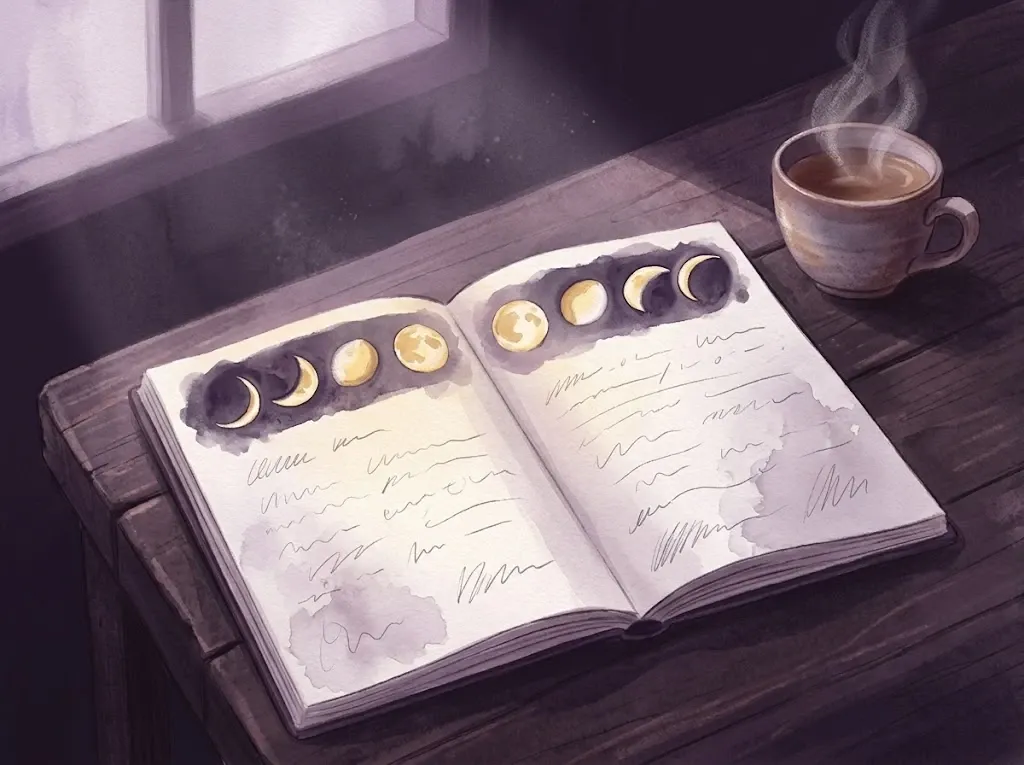
A simple monthly moon ritual
If you want a place to start, try this:
- At the new moon, write one intention and one feeling you want more of.
- At the first quarter, check in. What has helped, and what has gotten in the way?
- At the full moon, read back through the dreams of the past two weeks and write down anything that stands out.
- At the last quarter, write down one thing you are ready to release.
That is four short moments a month. Small enough to keep, meaningful enough to notice the difference.
Moon phases FAQ
How long is a full lunar cycle?
About 29.5 days from one new moon to the next. Because a calendar month is usually a little longer, a month occasionally holds two full moons.
Which moon phase is best for setting intentions?
Traditionally the new moon, when the sky is dark and the cycle begins again. But an intention set on any night is still an intention. The moon is a reminder, not a rule.
Does the full moon affect sleep or dreams?
Studies disagree. A 2013 lab study and a 2021 field study found later and shorter sleep around the full moon, while a 2014 analysis of more than 2,000 nights found no effect. Dreams have hardly been studied. More in what research says above. Your journal is the best place to find out what is true for you.
What is the difference between waxing and waning?
Waxing means the lit part of the moon is growing, from new moon to full moon. Waning means it is shrinking, from full moon back to new moon.
Is the moon phase the same everywhere on Earth?
Yes. Everyone sees the same phase at the same moment, although the moon looks mirrored in the Southern Hemisphere and the date of a new or full moon can shift by a day between time zones.
Look up tonight
The easiest way to begin is simply to step outside and find the moon. Notice its shape, and notice how you feel. That small moment of attention is where every ritual starts.
Minsence is a dream journal app that keeps your entries, links each one to the phase of the moon and helps you look back on your patterns. It is coming soon to iOS and Android. Join the newsletter to hear when it launches.